
8 June 2026
Layer 04 – Knowledge Capture: turning questions into repeat answers
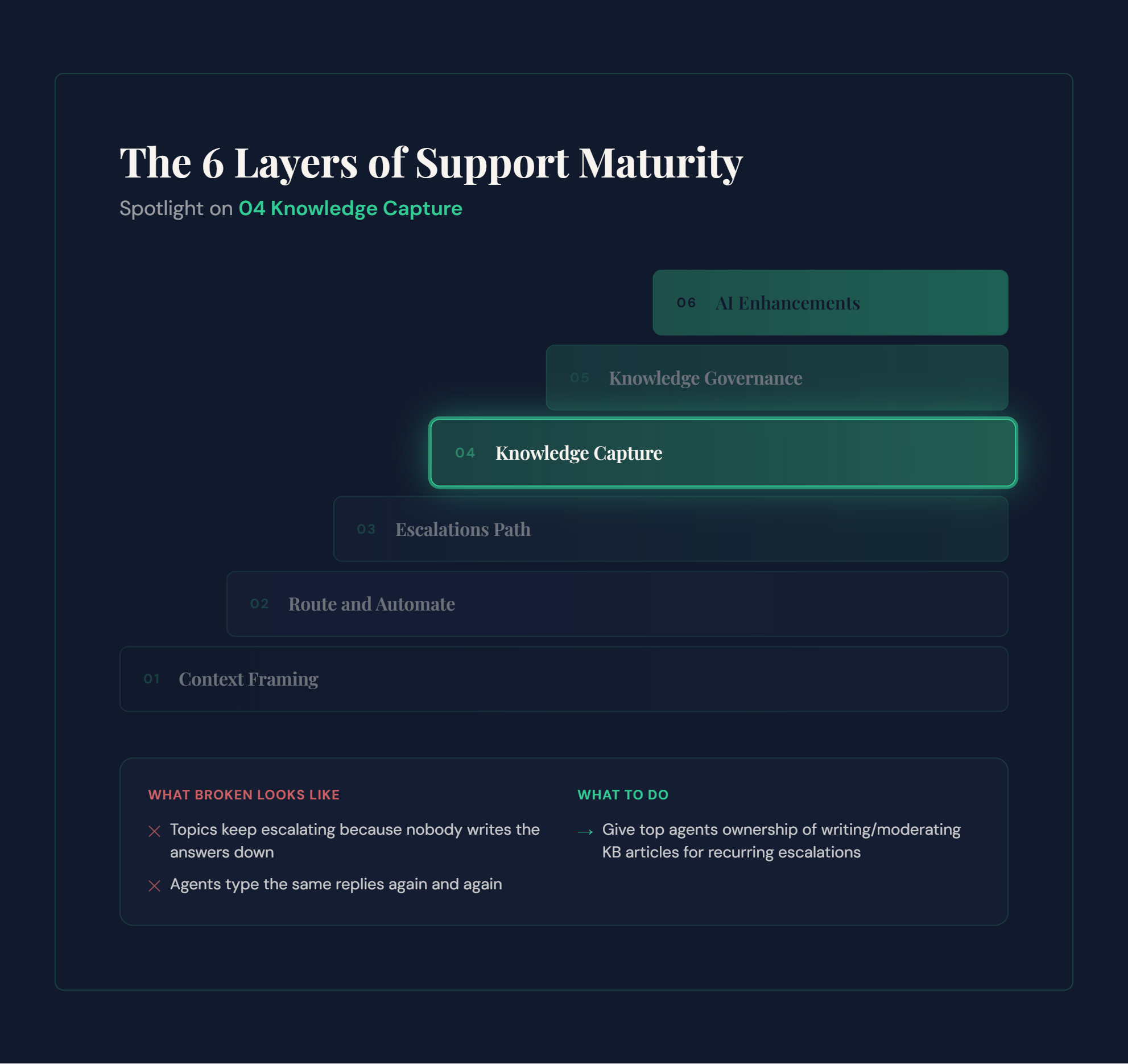
Knowledge Capture is the fourth layer of The 6 Layers of Support Maturity. It defines how we capture knowledge and turn it into a useful resource for your customers and internal teams. It is a continuous process that helps to reduce escalations.
After setting up context framing, routing, automations and escalations you will have a solid ticket workflow for handling the majority of requests in a timely manner.
But when the number of requests starts to grow, it is important to look at ways to deflect tickets before they even arrive. One of the most efficient ways to do this is to provide a platform where customers can find answers for themselves, such as a help centre, chatbot or FAQ pages.
But any of these self-service resources only work when there is a knowledge base behind it containing useful, relevant and up to date information. This should be a regularly updated set of articles which cover the most common topics customers ask about.
What a knowledge base is used for:
By providing these answers as self-service, it stops the need for customers to contact your support team with the most basic questions.
How often are your teams answering tickets like:
Where is my order?
How do I make a return?
Where do I reset my login information?
How do I update my profile?
Where do I download manuals or firmware?
All of these are typically covered by standard procedures which do not need to consume the time of a support agent to explain to the customer over and over again on repeat tickets.
The knowledge base can also contain complex workflows or troubleshooting steps which take time for a customer to work through.
Imagine your tech support team is spending 10 minutes per call walking customers through the same procedure to solve a repeat issue — putting that as a knowledge base article means customers can find the solution and work through it in their own time without taking up your tech support resources.
Internal use of knowledge:
Besides making the knowledge available for your customers, it is also available for your support teams and other people within the business.
This helps to reduce the number of escalations between support levels, avoid an unnecessary reliance on team leads or managers for repeat knowledge, and reduce the number of internal support requests from sales teams to your support teams.
How knowledge is captured:
So, how do you capture this knowledge?
Having a solid process in place to review regular support ticket topics is a good start. Simply asking one of your frontline agents what are the top 3 things they repeat every day to customers will surface a few important topics.
But to go further than this, training your agents (particularly the most experienced ones) to think in a process of “can I turn this ticket into a knowledge article” before just sending a reply to the customer means capturing knowledge right up front.
The customer still gets their answer, but the result is a happy customer and a new knowledge article to deflect the next customers from asking the same question.
Benefits:
Having regular requests documented can help save time for customers who can self-serve via the knowledge base, save time for agents as they can find the answers quickly, and ensure consistent replies to customers by embedding pre-written texts in ticket responses.
It is also the foundation for an AI agent to be able to serve your customers.
In the next article, we will build on this foundation with Layer 05 – Knowledge Governance. If you would like to discuss how Layer 04 applies to your environment, feel free to start a conversation with me.
The 6 layers of Support Maturity:
Layer 05 - Knowledge Governance (coming up in the next post)
Learn about the 6 layers of support maturity
Take the Support Maturity Assessment
Learn more about OPCX Solutions services
Book a discovery call