
30 April 2026
Layer 01 - Context Framing: Getting the right information, first time
Context Framing is the first layer of the 6 Layers of Support Maturity framework. It focuses on capturing the right information at the point of intake so every ticket arrives with enough context to be routed, handled, and resolved correctly.
This is not the most exciting part of a support journey, but it is fundamental to building an efficient and scalable support system.
Do customers complain that their question takes too long to answer?
How much time do your agents spend just trying to understand a customer’s question?
How many of your tickets reach the right group or agent first time?
What percentage of your requests can be handled as one touch tickets?
These are not isolated issues. They all have the same underlying problem. If these sound familiar, it is likely you have a context framing problem.
By context framing, we mean the processes used to consistently capture the right information about the customer and their request at the intake stage, whether that is a webform, email, phone, chat, or another channel.
Imagine a customer reporting a faulty device. When an agent receives a ticket that simply says “my device is faulty”, there is very little they can do other than go back to the customer with a list of follow up questions, such as:
Which country are you in?
What is the model and serial number?
Where was it purchased? Is it registered or under warranty?
What troubleshooting has already been attempted?
And the list goes on.....
Of course, this is all information the customer already knows, but they do not think to provide it because, from their perspective, the problem is simply “my device is broken, how do I get it fixed?”
So how do we solve this? By adding relevant fields to a dynamic webform or bot flow, where questions adapt based on earlier answers, we can capture much of this detail up front.
When the agent receives the ticket, they now know exactly who the customer is, what the device is, whether it is under warranty, and what the problem is. Most likely, the agent can now resolve the ticket as a one touch interaction by guiding the customer on the next steps.
This problem only amplifies as you add more teams and support more types of enquiries.
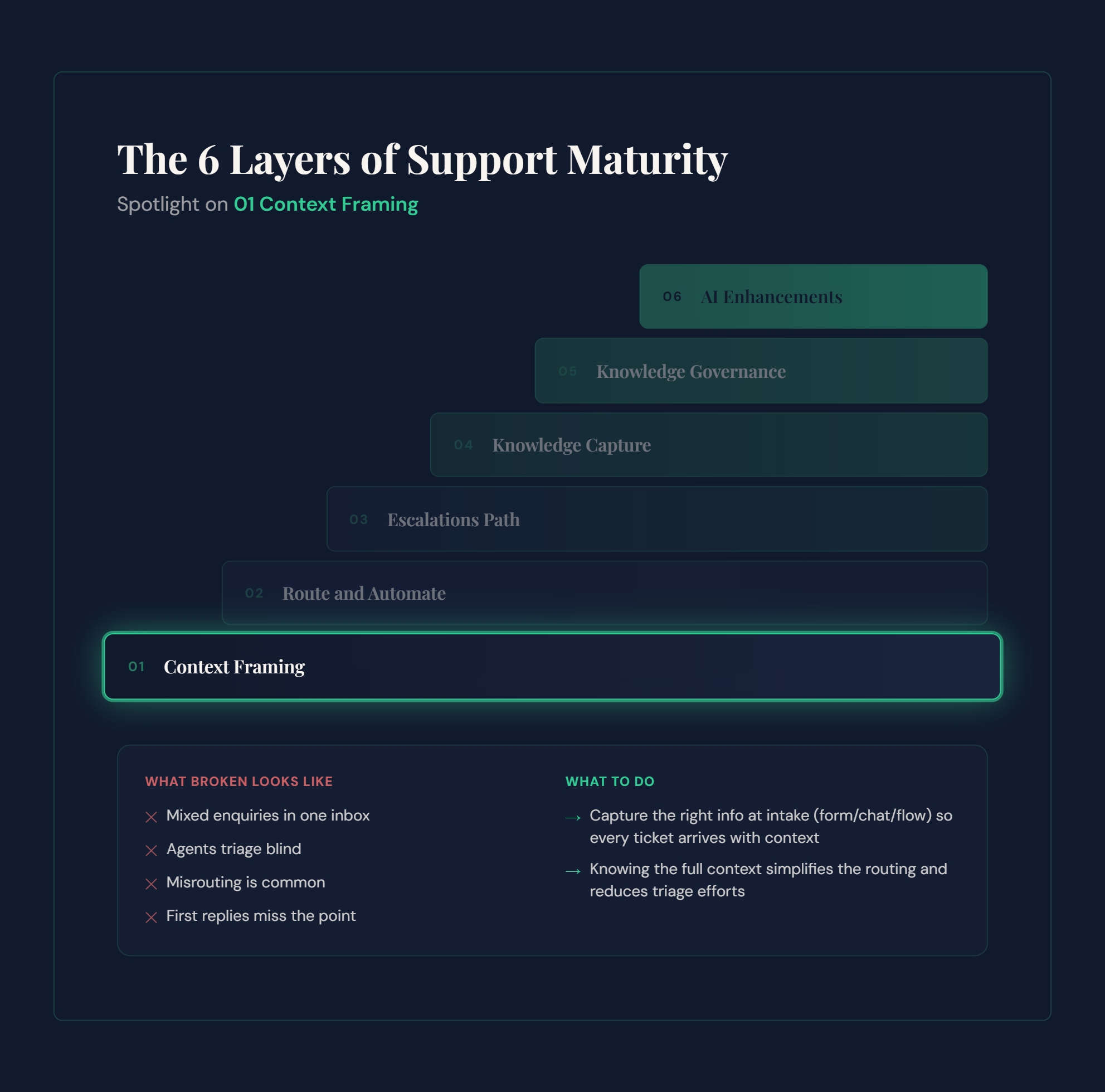
The right context not only helps agents understand requests, it also enables automated routing, assignment, categorisation, and task automation. Crucially, it lays the groundwork for an AI layer that can further enhance the support workflow.
If you skip this layer in your support system design, everything above it becomes reactive and inefficient. Customers wait longer, agents become frustrated, and both CSAT and ESAT suffer.
Many teams recognise they have a context problem, but struggle to define what “good” looks like for their specific support model. If that sounds familiar, our Support Maturity Checker can help you validate whether Layer 01, Context Framing, is the current constraint in your support operation.
In the next article, we will build on this foundation with Layer 02, Routing and Automation. If you would like to talk through your results or discuss how Layer 01 applies to your environment, feel free to start a conversation with me.
The 6 layers of Support Maturity:
Layer 02 - Route & Automate (coming up in the next post)
Learn about the 6 layers of support maturity
Take the Support Maturity Assessment
Learn more about OPCX Solutions services
Book a discovery call