11 June 2026
Layer 05 - Knowledge Governance: make your knowledge usable
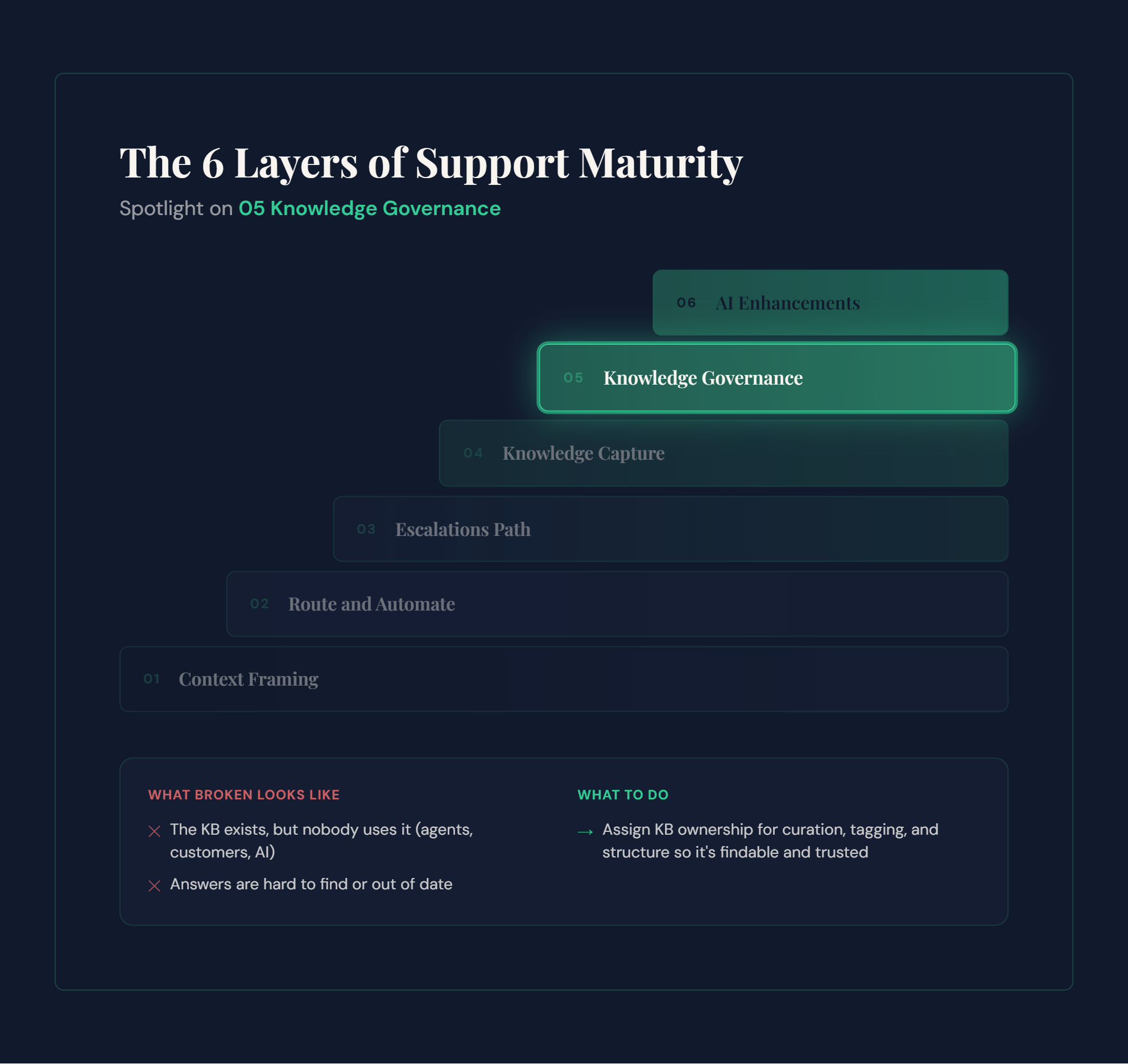
Knowledge Governance is the fifth layer of The 6 Layers of Support Maturity. It defines how we structure, organise and maintain the knowledge base to keep it usable and searchable.
Capturing knowledge is only the first step - getting people to use it is the next challenge.
Imagine a library with no shelves. Just a pile of books thrown on the floor. None of the books have titles… and there is no light in the room!
Now imagine trying to find some specific information from one of those books. It might take a while…!
Writing articles without governance is a bit like that room full of books - lots of useful information, but no way to find what you want.
Knowledge governance is about turning your articles into a useful resource where your customers, agents and AI can quickly look up what they want to know, with a clear reference structure. Just like an indexing system in a library, this means you can find the relevant information quickly.
Ownership:
The first step is to decide who owns the knowledge.
· Does someone feel accountable for it?
· Who is responsible for writing the articles?
· Who is curating, reviewing and publishing articles?
Without clear ownership and oversight your knowledge base quickly becomes messy, with difficult to find articles, out of date information and inconsistencies which confuse customers and drive more support volume for your agents to handle.
Structure:
Structuring your knowledge base defines how people navigate and find information through steps like:
· Organised into Brands, Categories, Sections and sub-sections
· Careful naming conventions on articles
· Tagging, Labelling and defined key-words in articles
· A clear folder structure
If there is no structure then customers won’t find the knowledge, agents won’t use it and you rely on people remembering information instead of being able to serve it up quickly and consistently.
Review and refresh:
It is important that knowledge is up to date.
· How often are articles reviewed?
· Is there version control?
· Are all language variants holding the same information?
· Has something new come along which has replaced this knowledge?
· How often is an article viewed and by how many customers?
· Does an article have lots of upvotes or too many downvotes?
Consistency:
If you end up with three different pages explaining warranty, returns and refunds, is the information consistent across all three?
Or does the knowledge guide match the legal documentation on your policies?
With too many differing sources of information, you can confuse customers, or worse end up committing to a policy which doesn’t really exist.
Making reusable content blocks which can be placed across articles can help to maintain consistency and reduce confusion.
Visibility:
Is it clear which are internal only articles versus external articles?
Maybe some information is intended only for a certain support level, or for a set group of customers?
Or maybe everything is public, versus only shown to logged in users?
Did an article get written but never published?
Unfinished articles or wrong visibility settings can mean the knowledge is written but never used.
Summary:
When you get ownership, structure, review cycles, consistency and visibility right, it makes natural language searching much easier, as well as having clear paths and structures for anyone who is browsing the knowledge base for help.
And finally - is your knowledge AI ready? When there is unstructured information, long pages of mixed Q+A's, or very deep technical explanations on a topic, that can make it hard to find relevant answers – proper structure can make answers more easily and reliably findable by AI solutions.
So, knowledge governance is like a library: shelves with books organised into topics, an indexing system, and replacing old books with new ones to stay relevant and up to date... oh, and remembering to turn on the lights by publishing the articles!
In the next article, I will build on this foundation with Layer 06 – AI Enhancements. If you would like to discuss how Layer 05 applies to your environment, feel free to start a conversation with me.
The 6 layers of Support Maturity:
Layer 06 - AI Enhancements (coming up in the next post)
Learn about the 6 layers of support maturity
Take the Support Maturity Assessment
Learn more about OPCX Solutions services
Book a discovery call