27 April 2026
The 6 Layers of Support Maturity
The 6 Layers of Support Maturity is a framework used in OPCX client work to diagnose why support operations struggle as they scale. Each layer builds on the one below, and improvements only stick when addressed in the correct order.
Is your support team dealing with increasing volume, complexity, or being asked to scale fast? Or are you under pressure to “add AI” without clear foundations in place?
This framework is for support teams and support leaders who need to add structure and clarity to their support systems.
Imagine a new support agent starting with your team. You don’t give them any training, documentation, knowledge base, or operating procedures. The first thing they do on day 1 is answer customer messages. It would be a disaster, right? Wrong answers, slow to respond, repeat messages, dissatisfied customers....
Now imagine the same agent, who has had a solid introduction training, is familiar with the knowledge base structure and its contents and knows where and how to escalate when the request needs to be passed on. They get a full working knowledge of the company's products, systems, and processes before they ever even see a request from a customer. When they get going, the responses should be well crafted, based on established knowledge, using the company's tone of voice. Right answer, first time, high CSAT.
When we expect all our support problems to be solved by just “adding AI” on top of a poorly structured support system, we are effectively adding new agents with no training, procedures or guardrails. And since the AI can answer multiple customers at once, it could be an explosion of wrong answers, and dissatisfied customers.
Adding AI on top of a poorly structured support system is like adding untrained agents at scale.
This is exactly why I developed my “6 Layers of Support Maturity” framework - to address getting the foundations right before adding AI chaos on top.
Support maturity defines how well the support system is designed to scale, stay consistent, and absorb changing needs and information.
Each layer of the framework represents an important structural part of the system, and if one layer is skipped, or badly managed, the whole system can fall apart. Furthermore, by adding “AI” as a layer on top, it will amplify any problems further upstream in the process.
Not every layer is important for every team right away – what matters is building the layers in sequence and not trying to skip a step to jump ahead to the AI “reward”.
So, what are the 6 layers of support maturity?
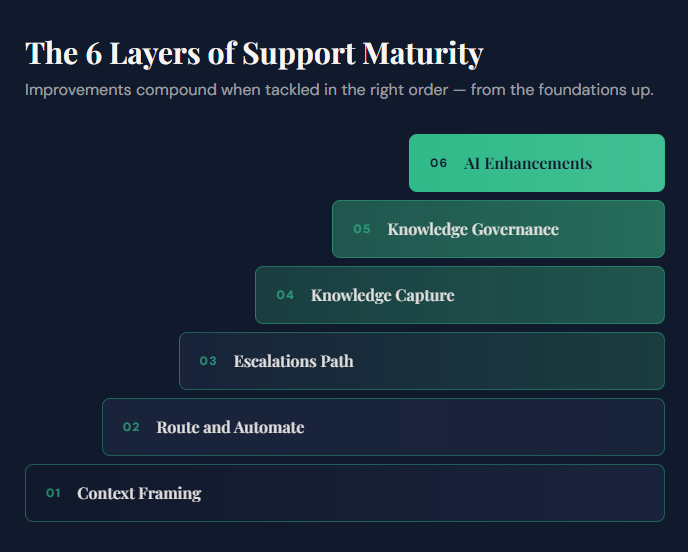
Layer 01 – Context Framing
When a customer contacts a support team, they know exactly what they want, but often the support agent does not have all the information they need from the customer. Context framing is about capturing that information (or contextually framing the request) by gathering as much information up front as possible to enhance the ticket data. This context is what makes effective routing and automation possible.
Layer 02 – Route and Automate
If the full context is known, like type of enquiry, reason for contact, or customer specific details, we can use this to route the ticket to the right team or agent first time. And we can ensure that when that ticket lands in the agents queue all the right information is shown in the right place. Furthermore, repeatable tasks can be automated or made easier for the agent to follow semi-automated procedures.
Layer 03 – Escalations path
Not every request can be solved at the lowest possible level, so sometimes requests must be escalated to a more senior agent, a specialist team, or a manager. Defining escalation paths, and the rules behind them ensure efficient escalations, reducing delays for the customer, and avoiding repetition of support steps.
Having regular requests documented can help save time for customers, who can self-serve via the knowledge base, save time for agents as they can find the answers quickly, and ensure consistent replies to customers, by embedding pre-written texts in ticket responses. It is also the foundation for an AI agent to be able to serve your customers.
Layer 05 – Knowledge Governance
Having the knowledge written down is the first step. Having it well structured, regularly reviewed and organised into a logical order, and tagged or labelled to be searchable makes it accessible and useful to agents. The same knowledge used by agents becomes the source of truth for AI.
Layer 06 – AI Enhancements
Once you have layers 01-05 in place, then adding AI on top can deliver results fast – the AI agent has access to a well-structured and complete knowledge source and has defined rules for routing and escalation of tickets it cannot answer.
This framework focusses on the structural layers that make support work.
Other elements such as workforce management (WFM), voice of the customer (VoC), SLA’s, KPI’s, and reporting metrics are still important, but they sit around the framework. They help to measure, manage and improve each layer, rather than build the support system.
We don’t ignore these elements, but they work best once the underlying support structure is in place.
I developed this framework based on many years working in support operations, seeing failure patterns repeat as teams push for new tools and automation before getting the foundations right.
In this blog series, I will explore further what each layer is and why it is important to build each layer before moving to the next.
Each of the next posts in this series will focus on one layer, starting with Layer 01 – Context Framing, and explain why it matters before moving on to the next.
The 6 layers of Support Maturity:
Layer 01 - Context Framing (coming up in the next post)
Learn about the 6 layers of support maturity
Take the Support Maturity Assessment
Learn more about OPCX Solutions services
Book a discovery call